
The Nippon Foundation-GEBCO Seabed 2030 Project announces new collaboration with Scripps Institution of Oceanography
The Nippon Foundation-GEBCO Seabed 2030 Project and Scripps Institution of Oceanography at the University of California San Diego have strengthened their collaboration with a newly-established Memorandum of Understanding (MOU). The main purpose of the MOU is to pursue the attainment of worldwide bathymetric data, and to increase humanity’s understanding of the oceans.
Seabed 2030 is a collaborative project between The Nippon Foundation and GEBCO to inspire the complete mapping of the world’s ocean by 2030, and to compile all bathymetric data into the freely available GEBCO Ocean Map. GEBCO is a joint project of the International Hydrographic Organization (IHO) and the Intergovernmental Oceanographic Commission (IOC), and is the only organisation with a mandate to map the entire ocean floor.
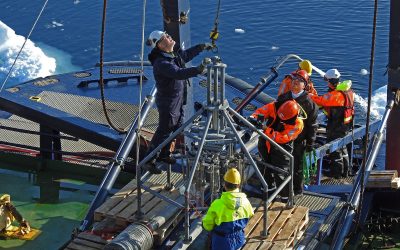
Founded in 1903, Scripps Institution of Oceanography is one of the oldest and largest centres for ocean and Earth science research in the world. The institution operates large open ocean-class research vessels for ocean exploration with instrumentation for seafloor mapping.
Scientists at Scripps Oceanography use global marine gravity models, derived from satellite altimetry, to interpolate and predict seafloor depth at low spatial resolution in areas devoid of depth soundings – roughly 80% of the deep ocean floor. These global predicted depth maps provide the foundational layer for the Seabed 2030 grids.
“Seabed 2030 is pleased to welcome the support of an established institution such as Scripps, in our pursuit of producing the complete map of the world’s oceans,” commented Jamie McMichael-Phillips, Director of Seabed 2030. “Collaborative working is fundamental to our mission, and we look forward to progressing our goal as we enter the UN Decade of Ocean Science for Sustainable Development.”
Dr David Sandwell, Professor of Geophysics at Scripps Oceanography said: “Scripps is committed to protecting the planet. By investigating our oceans, Earth and atmosphere, our scientists are able to better understand the world we live in and offer solutions to some of our greatest environmental challenges.
“Scripps is dedicated to research that will have an impact, and a complete map of the ocean floor will have an immeasurable impact on the future of our planet.”
All data collected and shared with the Seabed 2030 Project is included in the GEBCO global grid – the most complete bathymetric dataset of the world’s ocean floor, which is free and publicly available.
ENDS
For media inquiries, contact:
Patrick Orr
patrick@raittorr.co.uk
+44 (0)7917 431102
Pegah Souri
pegah@raittorr.co.uk
+44 (0)7951 581707
Scripps Institution of Oceanography at UC San Diego is one of the most important centres for global earth science research and education in the world. Scripps scientists work to understand and protect the planet by investigating our oceans, Earth, and atmosphere to find solutions to our greatest environmental challenges. Scripps leads research in climate change impacts and adaptation, resilience to hazards, conservation and biodiversity, oceans and human health, national security, and innovative technology to observe the planet.
Find out more about Scripps Institution of Oceanography.
Lauren Fimbres Wood
(858) 337-1360